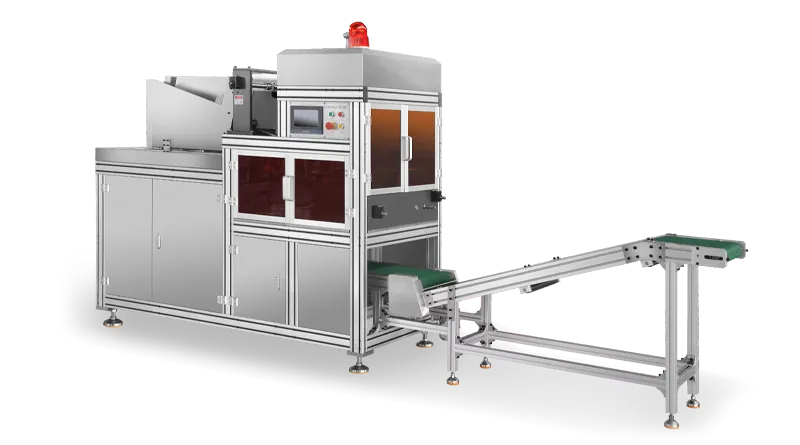
Thick cardboard cartons have a simple job: fold precisely, stay folded, and look flawless on the shelf. But if you’ve ever opened a fresh box of luxury spirits, electronics, or cosmetics and seen a hairline crack along the fold line – or watched the flaps push back open because the crease lost its memory – you know how fast that premium impression collapses.
Most of the time, the board itself isn’t the problem. Neither is the glue, the design, or the operator’s attitude. The real culprit lives a few millimetres deep: the crease formation settings on the converting line. When those settings aren’t tuned for heavy, multi-ply board, even a paper box making machine with an otherwise solid reputation can produce inconsistent results. The good news is that with a few systematic adjustments – no black magic, just physics – you can turn crease stability from a daily headache into a reliable, measurable parameter.
Let’s walk through the settings that actually move the needle, in the order they affect the board.
The creasing rule isn’t just a strip of steel. Its tip radius, height, and hardness decide how the board fibres are reshaped. For boards above 400 gsm – especially rigid grades like SBS, FBB, or micro-flute laminated sheets – a standard 0.71 mm (2-point) rule with a sharp shoulder can shear the inner plies instead of gently delaminating them.
What works on heavy board:
Rounded tip rules with a tip radius of 0.2–0.3 mm. These compress the board gradually, forming a trough-shaped delamination zone without cutting the bottom liner.
Height relative to cutting rule: the creasing rule should be 0.1–0.15 mm lower than the cutting knife for boards above 500 gsm. This ensures the board is pushed into the matrix channel before the knife touches, preventing sideways fibre rupture.
Hardness: choose a rule with a hardness around 52–55 HRC for long runs – softer rules wear quickly and their radius flattens, making creases progressively sharper and more crack-prone.
A practical check: after creasing, gently bend the sample 90 degrees and look inside the fold. You should see a smooth, continuous delamination bulge, not loose fibres or a sharp cut line.
If the creasing rule is the hammer, the matrix is the anvil. Most converters remember to match the channel width to the total board thickness (rule thickness + paper thickness), but thick cardboard throws in an extra variable: compression recovery.
For boards thicker than 0.8 mm, channel width needs an extra 0.1–0.2 mm allowance above the standard formula (usually channel width = 1.5 × board thickness + rule thickness). Why? Because heavy boards compress during creasing and then spring back, grabbing the sides of the matrix channel. A too-narrow channel clamps the crease and tears the inner layers.
Channel depth matters equally. A depth of 0.3–0.4 mm is typical for thin stock, but for 600–800 gsm boards, start at 0.5 mm and test from there. If the crease bulges excessively on the reverse side, reduce depth by 0.05 mm increments until the liner remains intact. Use a matrix with a flat-bottom channel rather than a V-shaped one – it gives more consistent support across the crease width and reduces the risk of the board bottoming out.

Even with perfect rule and matrix geometry, a crease will fail if the pressure isn’t uniform across the entire length. On heavy stock, an out-of-parallel platen or a worn chase can create sections where the crease is too shallow (leading to spring-back) and sections where it’s too deep (cracking). The stiffness of thick board amplifies these pressure differences – there’s no “averaging out” as sometimes happens with thin, flexible stock.
Actionable steps:
Use a pressure indicating film or carbon paper impression to check parallelism at least twice per shift. Look for density variation exceeding 5%.
Spot-check crease depth with a digital calliper along the entire crease line. Tolerance should be within ±0.02 mm.
On rotary systems, check the anvil drum runout and cylinder bearing clearance. Even 0.05 mm of eccentricity can pulse the crease pressure and create a wavy fold line on stiff board.
When the mechanical condition of the creasing station is dialled in, operators are no longer fighting a moving target. At that point, fine-tuning becomes repeatable and can be captured in a setup sheet for each board grade.
Some boards – like 1.2 mm greyboard or clay-coated Kraftback – simply won’t form a stable crease in one pass without surface cracking. Here, pre-creasing becomes essential.
Pre-creasing means running a narrow, shallow impression slightly ahead of the main crease rule. This softens the fibre structure without fracturing the top liner. The main crease, immediately following, completes the delamination cleanly. On flatbed machines, this is achieved with a second creasing rule parallel to the first, about 1.5–2 mm ahead. On rotary systems, a separate creasing station does the same.
A related technique is the double-hit crease on the same line: the first hit at 70% pressure initiates fibre separation, the second hit at 100% finishes it. Double-hit settings require a press capable of rapid stroke adjustment or a forming section with servo-controlled ram movement – it’s very difficult to execute consistently on mechanical stops. However, many high-throughput lines are now adopting closed-loop force control that dynamically adjusts each stroke. This approach is especially valuable if you run mixed batches of lightweight and heavy board on the same line without retooling.
Neglecting grain direction is like tuning an engine but ignoring the fuel. Creases made parallel to the grain (machine direction) delaminate easily and resist cracking, while cross-grain creases are inherently more brittle and require wider matrix channels and shallower penetration. Always design cartons so that the primary crease lines run parallel to the grain whenever possible. When it’s not possible, mark the cross-grain creases on the job ticket and apply the adjusted settings documented in your heavy-board playbook.
Moisture content is the invisible hand. Paperboard at 6–8% moisture creases beautifully; below 4%, fibres become glassy and crack-prone. In dry winter conditions or air-conditioned plants, let board acclimate for 24–48 hours in the production area before converting. A simple conditioning tracking system – even a humidity log – can correlate crease failure spikes with ambient conditions and solve “mystery” quality problems without touching a single machine setting.
None of these adjustments exist in isolation. A creasing rule perfectly matched to the board won’t save you if the pressure is uneven. A precision matrix is wasted if the machine’s frame flexes under load. That’s why so many carton converters chasing rigid-box or heavy display work eventually look at their entire forming setup rather than tweaking one parameter at a time.
If you are producing premium thick-cardboard cartons with high aesthetic expectations, the difference often comes down to a system that gives you independent control over creasing depth, pressure dwell time, and repeatability.
Beyond the machine itself, the setup workflow matters. The best operators aren’t the ones who guess – they’re the ones who measure, record, and adjust within a structured framework. When you pair a well-documented creasing protocol with Forbona’s automated forming systems that store recipe-based settings for different board grades, the morning shift change stops being a gamble. Jobs run repeatably, and the crease stability you achieved during first-article inspection stays locked for the entire order.

If you’re still experimenting with shimming tapes and manual pressure wheels every time a new board batch arrives, consider stepping back to review not just the settings but the platform delivering them. Get a personalized machine configuration recommendation from Forbona’s application team and see how a paper box making machine designed around heavy board challenges eliminates the common failure points described above. It’s rarely about buying more speed – it’s about building consistency into the crease, one carton at a time.
Rule tip radius ≥ 0.2 mm; rule height 0.1–0.15 mm below cutting knife
Matrix channel width = (1.5 × board thickness) + rule thickness + 0.1 mm extra
Channel depth starting point 0.5 mm for boards > 500 gsm
Pressure parallelism checked; ≤ 0.02 mm depth variation along crease
Pre-crease or double-hit enabled for boards ≥ 1 mm thick
Cross-grain creases flagged and processed with wider channels
Board moisture between 6–8%; acclimated before converting
Recipe settings stored for each board grade, complete with rule/matrix specs
The creasing channel formulas referenced are derived from industry practice and align with guidelines presented by the International Association of Diecutting and Diemaking (IADD). Board moisture recommendations follow TAPPI T 402 conditioning standards. Performance results depend on specific board composition, machine condition, and operating environment; the settings offered here are starting points for systematic testing, not universal guarantees.
This article is for informational purposes and does not replace on-site machine qualification and process validation.

Key node quality report push
Equipment performance test report
Old equipment upgrading program
Lifetime technical support
Professional engineers 1 to 1 program design